
About the studio
Founder-built. Not handed off.
Spider Digital Group is Ian's studio, and Ian builds the websites himself. You work directly with the person doing the work — the one whose name is on it, not a junior.
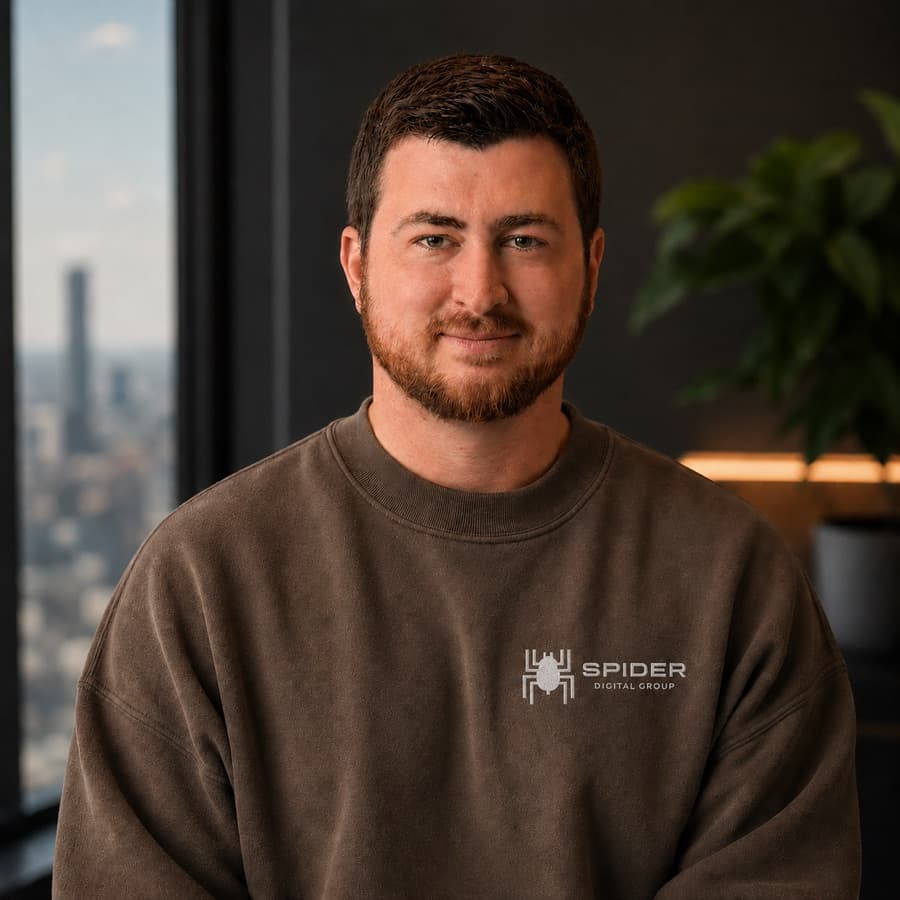
The founder
Ian Ciamarra
Ian founded Spider Digital Group in 2022 and builds its websites himself. Before that he worked at a large agency, on Fortune 500 accounts. He lives in North Carolina and works remotely with industrial companies across the US.
How he thinks about the work — what a site is for, and what he will not promise — is set out in his own words rather than summarized here.
Read our approach- Call
- 202-318-5500
Founder-built
The person in your first call is the person writing your code.
Ian founded Spider Digital Group and builds its websites personally. Support help covers only the digital-marketing fulfillment — the posting, the scheduling, the day-to-day — and that split is deliberate: it keeps his plate clear so the builds stay with him and nowhere else. It is the part of the business he cares about most, so it is the part he keeps for himself.
- You talk to the builder directly from first call to launch, so nothing is relayed second-hand.
- One person carries the project through discovery, design, and code, so nothing is passed between hands and re-learned along the way.
- When a decision needs making or something needs fixing, it reaches the person who wrote the code.
Where the standards come fromBuilt in places where a mistake isn’t a bad look. It’s a breach.
The bar Spider Digital Group builds to wasn’t picked up from a blog post. It was set on work like this, where security, accessibility, and data handling are reviewed by people whose whole job is to find what you missed.
- U.S. Army
Defense cyber environment
A setting where security is the mission itself — the standard starts strict and never relaxes.
- U.S. Navy
Service-branch public heritage
Public-facing heritage work for a service branch, built to the standard it holds its own name to.
- U.S. Army
National museum presence
A national museum's public presence, where accessibility and long-term durability are the baseline, not extras.
- U.S. Navy
Patient-data handling
Complete, native HIPAA-compliant patient-data handling — built on work that involved medicines, where the data was real and the stakes were real.
Work delivered inside U.S. Army and U.S. Navy environments. We describe the scope and the constraints; we don’t name the owners in marketing. Details on request.
The standards behind every build.
Not add-ons for the clients who ask. The baseline every SDG site starts from.
Security-first, defense-grade
Built the way government work demands — the site is treated as something that has to hold, not just something that has to launch.
Zero Trust architecture
Every request verified, nothing trusted by default. It is the model the strictest environments now run on, applied here as the starting point.
SOC 2 controls
The access, logging, and handling discipline an enterprise security review expects to find — built in rather than bolted on later.
The strictest accessibility bar
The ADA and accessibility level required of .gov, .mil, and .edu — so the site holds for every visitor, and for every audit.
Native HIPAA
Patient-data handling built in from the ground up, proven on real work where a mistake would have been a breach.
Two sides, one builder
Two worlds that rarely meet in one builder.
Rules aren’t optional.
Security, accessibility, and data handling where a mistake is a breach — held to a review that assumes nothing passes until it has proven it does. Passing that kind of scrutiny isn’t a feature you turn on. It is how the work is built from the first line.
The numbers have to move.
Speed, SEO, conversion, and leads — the site earns its place by what it brings back. A page that passes an audit but never turns a visitor into a call hasn’t done its job either.
Most studios are fluent in one. You shouldn’t have to choose between a partner who can pass an audit and one who can grow your pipeline — and with a founder who works in both, you don’t.
The stack
Built on the enterprise default.
Every SDG build runs on Next.js, Tailwind, Supabase, and Vercel. It is a proven, modern foundation that large engineering organizations run in production every day — not a bespoke experiment your site becomes the test case for.
Companies that run the same stack
Named here as companies that run this stack — not as clients of the studio.
Ownership
You own what gets built.
The code, the domain, the analytics, and every login live in your name from day one. Nothing is held on the studio's servers as leverage, and nothing needs anyone's permission to move. When the site is yours, it stays yours — including the freedom to take it anywhere.
- The codebase and repository are handed over in full — no locked platform, no rented template.
- Domain, analytics, and every account key sit under your login, not the studio's.
- Built to run without us in the room, because eventually a good site should.
Tell us what you're building, and we'll map the route from here.
You'll hear back from the founder who would do the work.